On Tang and Choosing a Knife for a Character

225px-Michaelmyers2007Ah, the crisp, refreshing zing of a cold glass of Tang. Is there anything better than that in the morning? Can’t kick things off without an astronomical dose of orange-ish vitamin C.

Wait, we’re talking about knives? In that case, stop drinking Tang (uppercase T) and start thinking tang (lowercase t).

A knife’s tang is an important feature to consider whenever assigning a character a hard-use blade. By that I mean the kind of knife slated for a workout slashing and slicing its way through a story. Continue reading
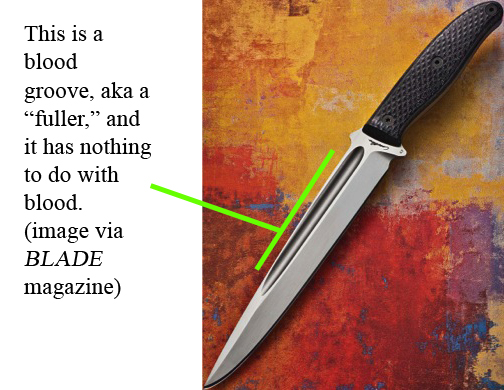
What are Blood Grooves?

“Blood grooves” sure do sound cool, don’t they? The term is a hair away from “gore trench,” “kill ditch” or “splatter line.” All of these would make for fine garage band names, but we’re talking about knives here. And that’s why I need to clear something up about blood grooves.

Blood grooves consist of a long depression cut into a blade. Here’s an example.

What are Blood Grooves

Continue reading

When a Firearm Is Not the Most Deadly Weapon

Didn’t want you writer folks to miss out on this article by Massad Ayoob over at GunDigest.com, The Dangerous Myth of Hierarchy of Lethality. Ayoob, one of the world’s foremost authorities on firearms and self-defense, details the situations where a firearm is not the most deadly weapon on the scene. Although his article his aimed at the gun crowd, there’s plenty in here to think about for writing. Continue reading

What is an AR-15?

AR15A4_700w


Image via Colt

I was enjoying a novel the other day until a character switched an AR-15 (pictured above) into fully automatic mode and started blasting away at bad guys. Thing is, AR-15s don’t have a full-auto mode. It’s time to clear the waters, because this is only one of the misconceptions. Continue reading

Three Reasons I Do Not Cut Down Other Writers

felled-tree-1424452-mIn my book, The Writer’s Guide to Weapons, and on this blog, I draw inspiration from the mistakes I encounter in what I read. However, I don’t call out the writers making them. There are three good reasons why. Continue reading